Demographic and phenotypic signals of population responses to environmental change
A major goal in biodiversity conservation is to predict how wildlife populations will respond to environmental change, early enough to act. Earlier work had looked for early warning signals of collapse in population counts alone. Recent studies, however, showed that shifts in individual traits such as body size often accompany, and sometimes precede, sudden changes in population dynamics. This project set out to combine the two: to find the demographic and trait-based statistics that warn of a population’s decline.
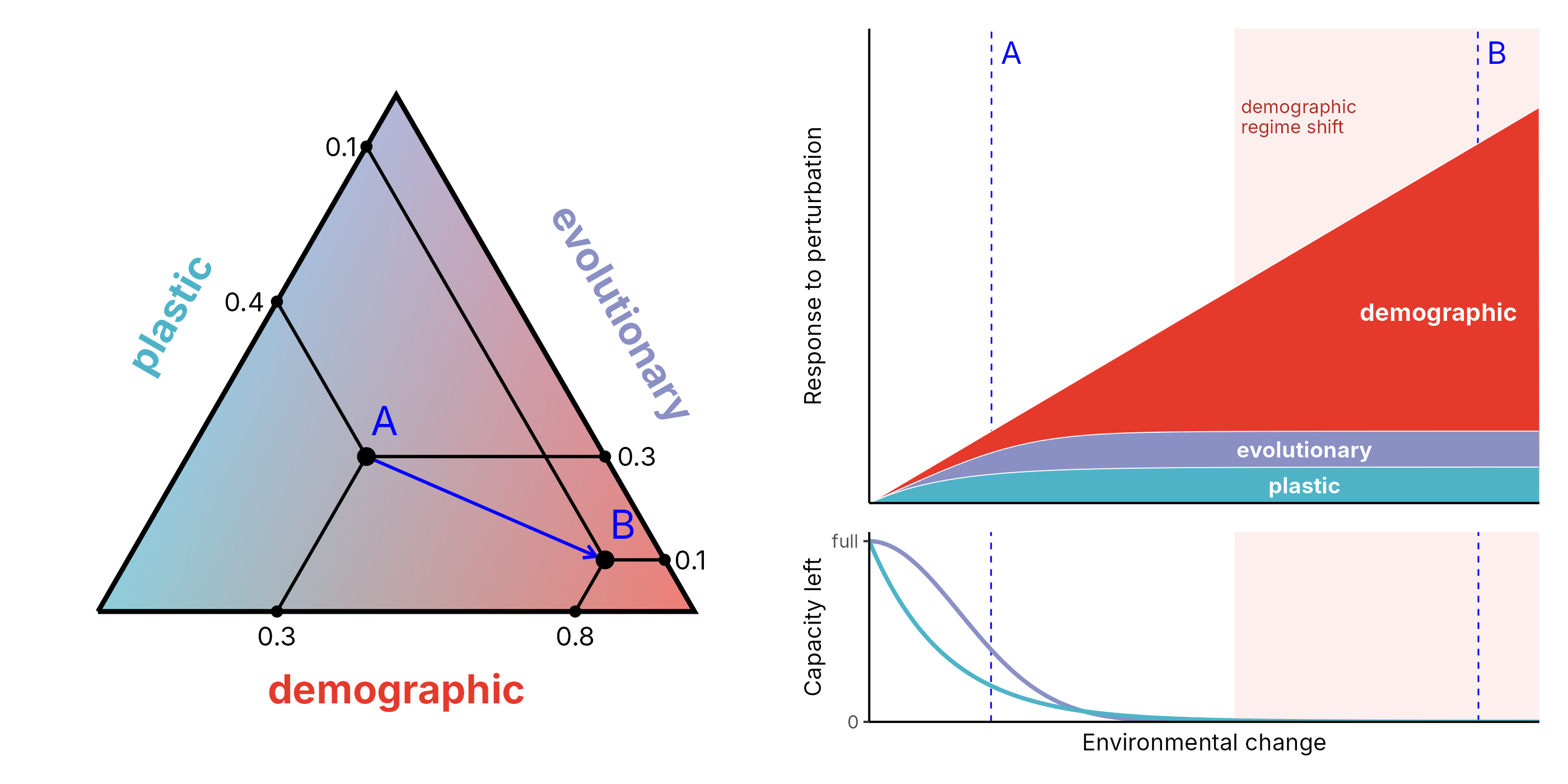
We worked towards three goals.
Trait–demography relationships in natural populations. We built trait-based demographic models for seven long-term, individual-based studies: Alpine and yellow-bellied marmots, prairie voles, Soay sheep, African striped mice, Kalahari meerkats and wandering albatrosses. Each gave its own insight. In Alpine marmots, plastic responses to environmental change become clear only when several traits are considered together. In Soay sheep, a trade-off between reproduction and growth lasts throughout life. In African striped mice, external and internal factors interact in shaping population responses. In meerkats, environmental factors destabilise population dynamics through body mass, while social factors stabilise them directly. In prairie voles, body mass fluctuations came mostly from growth, while population fluctuations depended on fecundity, maturation and juvenile survival. In wandering albatrosses, changing winds affected body mass and how much each sex invests in offspring. We also reviewed four frameworks that split trait change into evolutionary, plastic and demographic components.
Early warning signals in simulated populations. Using these models, we simulated population and trait dynamics under many environmental scenarios and tested which statistics warn of a coming collapse. We also showed how noisy, subsampled monitoring data weaken the classic abundance-based warning signals.
Tests in experimental systems. With laboratories at the University of Leeds, we used soil mite experiments to separate the effects of the current environment, the past environment, maternal effects and body size on demographic rates. In rotifers and protists, we showed that adding the dynamics of a trait such as body size to abundance data predicts an approaching collapse more reliably than abundance alone.
Among the results: combining trait-based and abundance-based signals in a single measure of risk improves the prediction of population collapse, and declining body size and early warning signals preceded the historic collapse of whale stocks (Shrinking whales and warning signals). The project’s focus on prediction also led to the concept of an ecological forecast horizon, developed with colleagues, which measures how far ahead useful forecasts can be made.
Years: 2013–2018
Funding: European Research Council (Starting Grant SPREC) • SNSF • Marie Skłodowska-Curie Actions (fellowship to Cindy Canale)
People: Chris Clements, Koen van Benthem (PhD student), Gaurav Baruah (PhD student), Tina Cornioley (PhD student), Cindy Canale, Mollie Brooks, Stefan Sommer
In collaboration with:
Diego Fontaneto (Water Research Institute, National Research Council of Italy)
Henri Weimerskirch (CNRS, Centre d’Études Biologiques de Chizé)