African wild dog demography and dispersal
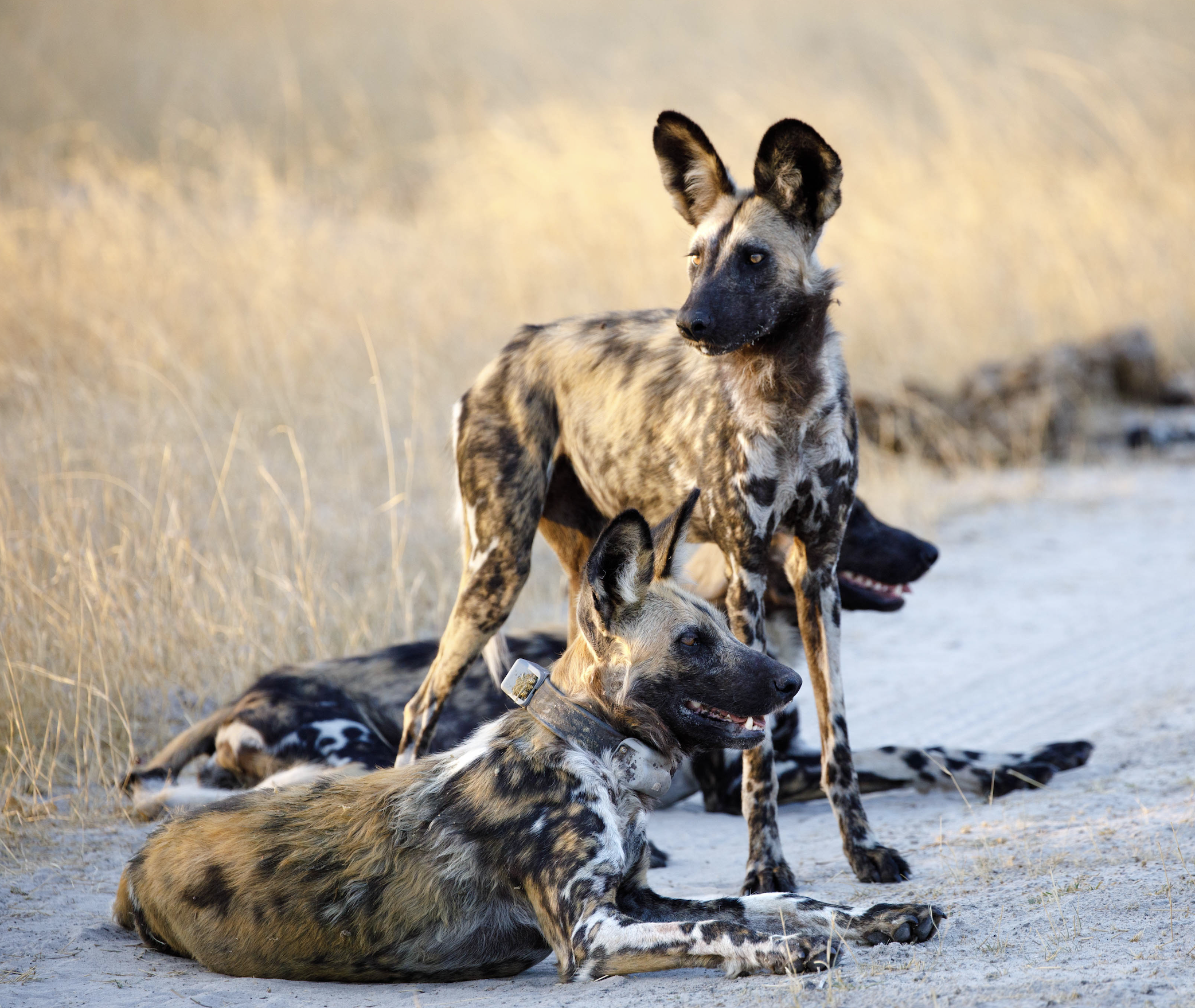
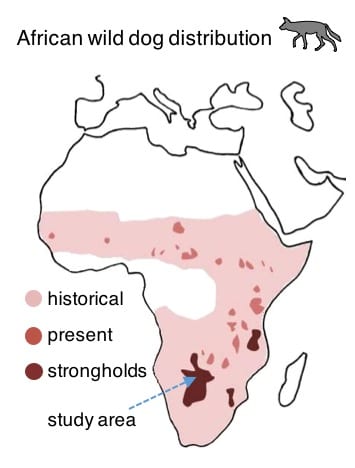
In collaboration with Wild Entrust (formerly Botswana Predator Conservation), we study the demography and dispersal of African wild dogs in the Okavango Delta, Botswana.
The African wild dog (Lycaon pictus) is one of Africa’s most endangered large carnivores. Fewer than 6,000 free-ranging individuals survive, in small and increasingly isolated subpopulations. Dispersing individuals connect these subpopulations: they found new packs, rescue small groups, and recolonise unoccupied areas. Yet dispersers travel long distances and are hard to follow, so their fate has largely been missing from population models.
We fit GPS/satellite collars to young wild dogs that leave their natal pack and record where they go, whether they survive, and whether they settle and breed. We combine this information with three decades of individual-based life-history data on resident packs in spatially explicit demographic models. These models allow us to assess population viability and landscape connectivity across the Kavango Zambezi Transfrontier Conservation Area (KAZA), for which the wild dog is a flagship species, and to inform national and international management plans.
How you can help
We identify individual wild dogs from photographs. If you have pictures of wild dogs from the region, see our call for African wild dog pictures or write to .
Video
A three-minute introduction to the project (in Swiss German).
Funding: University of Zurich, Swiss National Science Foundation, National Geographic Society, Idea Wild, Jacot Foundation, Parrotia Foundation, Temperatio Foundation, Basler Foundation for Biological Research, Albert-Heim Stiftung, and Wilderness Wildlife Trust.
People: Lukas Bierhoff, Lucy Novovitch, David Homoláč