Where can wolves live in Switzerland, and where are they welcome?
About one third of the Swiss landscape offers good wolf habitat. Yet the wolf is accepted by local people in only a small part of it. In our new paper in Journal of Applied Ecology, led by Dominik Behr and coordinated by Gabriele Cozzi, with Arpat Ozgul, we show where the two overlap: the places where wolves are most likely to settle in the coming years.
By the end of the 19th century, wolves had been wiped out in Switzerland and in large parts of Europe, including France and Germany. Once they were protected by law, their numbers grew and they started to spread again on their own. In 1995 a wolf was confirmed in Switzerland, and sightings have increased since. Large forests with little disturbance make about 13,800 km² of the country good wolf habitat. Yet wolves have spread more slowly here than in other parts of Europe. Wolves increasingly live close to people, so we wanted to find the places that suit them in both ways: good habitat, and people who accept them.
Mapping how people feel about the wolf
We sent a questionnaire to 10,000 randomly chosen residents of Switzerland, and 3,142 sent it back. Combining their answers with where they live, we drew a map of how much people accept the wolf across the whole country. Acceptance was lower the higher up in the mountains people lived, and lower still where many sheep and goats are kept. It was also lower close to places where wolves had been seen, and higher in densely populated areas. People who saw the wolf as dangerous to humans, or as harmful to livestock and wildlife, were mostly against it. Younger people, and people who thought the wolf is good for nature, were more positive.
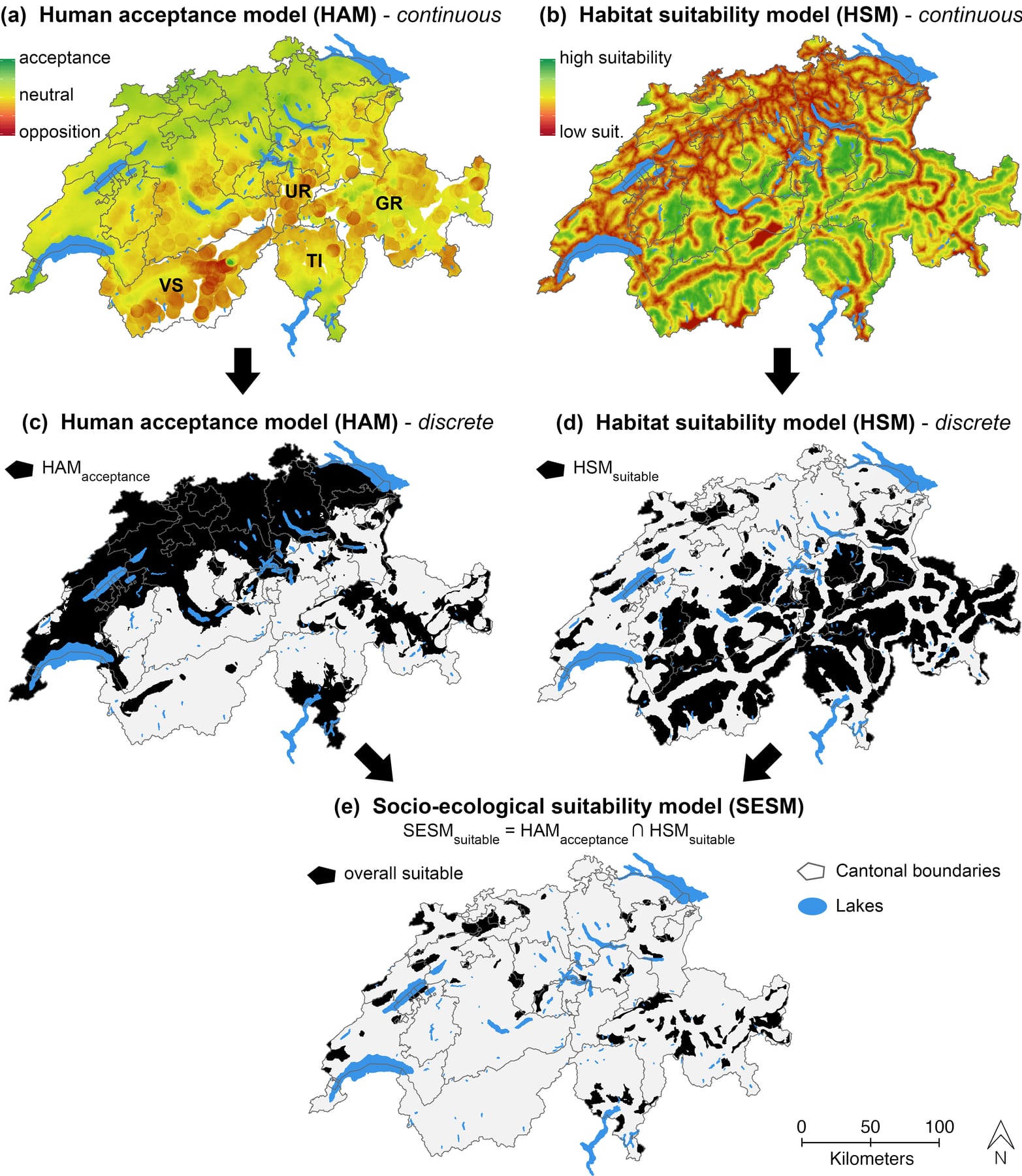
When we laid the acceptance map over the habitat map, the two overlapped on only about 6% of the country, mostly in the Jura Mountains and the eastern and southern Alps. In the western and central Alps there was none. A habitat map alone would have said a third of the country. As Arpat put it: “As wildlife biologists, we are good at understanding the ecological factors determining the suitability of a habitat for a wildlife species. Due to ever-increasing overlap between human and wildlife, however, we are obliged to take into consideration how human acceptance modifies our ecological description of habitat suitability.”
A new way to manage wolves and people
Our combined map matches where wolves have actually settled in Switzerland in recent years, including the areas with a lot, some or little conflict. The places with good habitat and accepting people are where wolves are most likely to settle next. The map also shows where it is most important to plan ahead and to bring everyone with a stake in the wolf together to talk, for example in the Jura, which wolves have yet to reach. The same approach can be used for other animals whose future depends on how people feel about them.
A big thank you to the 3,142 people who returned the questionnaire: this study would not have been possible without them.