A collaborative success story – how tourism can help research and benefit from it
For the past few years, together with Botswana Predator Conservation (BPC) and with the support of Botswana’s Department of Wildlife and National Parks, we have fitted GPS satellite collars to young African wild dogs as they leave home (this is called dispersal). We want to find out (i) how the landscape affects how far, how long and where they travel, and (ii) how many survive, settle in a new territory and go on to breed.
Recently, an unusually large group of eight brothers born in 2018 left their pack in the Third Bridge – Budumtau – Xini area of Moremi Game Reserve. Their collar sends GPS positions to us by satellite, so we could follow them from afar. In only five days they covered over 175 km, until they reached the permanent swamp around the Kwedi Concession in the north of the Okavango Delta. For the past month they have stayed in an area of about 180 km² between Vumbura Plains Lodge and Mapula Lodge.
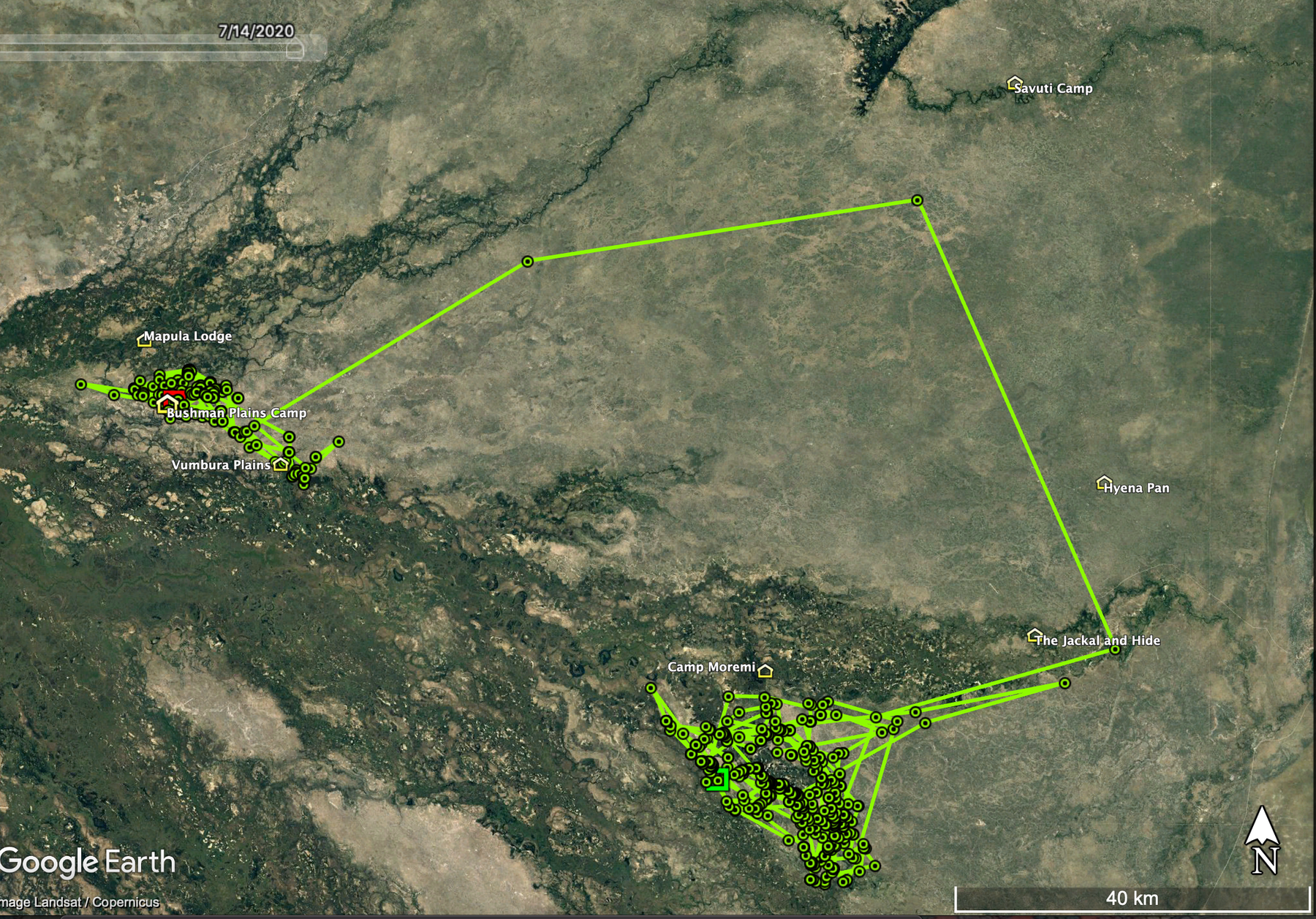
But dots on a map represent only a small part of the story… Are the eight brothers still together? What have they been doing? Have they met unrelated females and formed a new pack?
Although the collar sends us regular information, keeping up with the dogs over such large areas is almost impossible, unless we can capitalise on “the many eyes out there”. Tourists, guides, camp managers: all can contribute their sightings to research. No sooner said than done. We told the lodges that the dogs were in their area and asked them to report every sighting and send as many photos as possible.
Just a few days later, lodge staff saw a group of 9 dogs, including one with a collar, a few kilometres north of Vumbura Plains. From the photos we recognised five of the eight brothers and four unknown females. So the brothers had split up. But had the other three gone their own way, or had they died? A week later came the answer: a sighting of 12 dogs near Bushman Plains camp. In the photos we found the three missing brothers, alive and well.
Will this new pack of 12 stay together? Only one male and one female in a pack become dominant and breed; the others help raise the pups. So some dogs may take the extra risk and leave again to start their own pack (this is called secondary dispersal). Bets are open, and chances are that the three brothers will part again. Time, and your sightings (!), will tell.
We researchers can benefit from any reports and sightings, as has been the case here. In return, we bring all the pieces of the puzzle together and share what we learn with decision makers, local partners and the tourism industry.
Please keep sharing your sightings of wild dogs, with or without collars, to help us protect these amazing animals: how you can help (PDF).