Big toads win, old toads lose out
Every spring, common toads gather at their breeding ponds, and the males far outnumber the females. Which males get to mate? In our new paper in Animal Behaviour, led by Daniel Breitenmoser and based on his MSc thesis, we answer this with 41 years of data from a pond in the Swiss Alps.
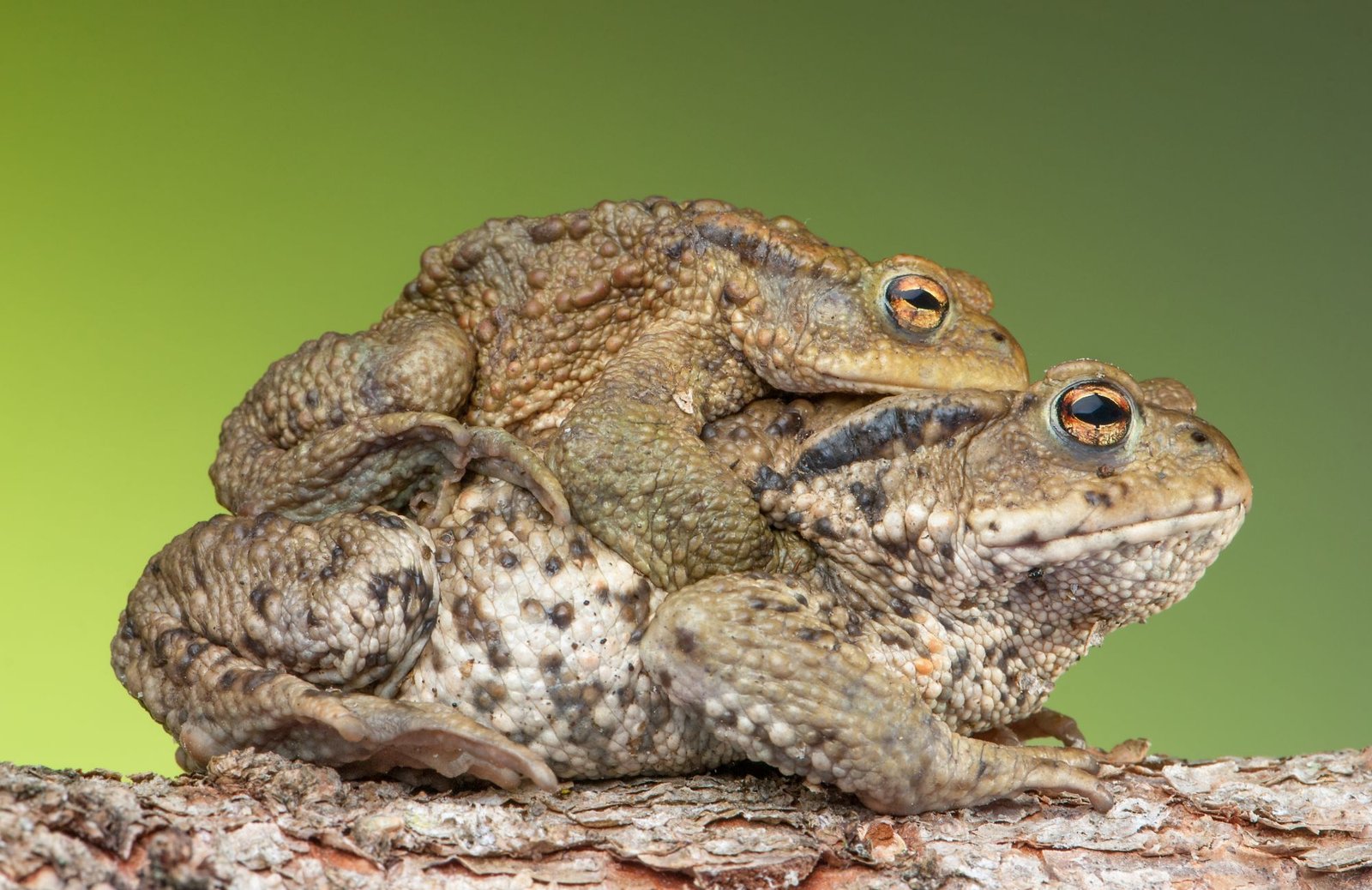
Common toads are explosive breeders: right after their winter rest they all head to the pond within a few weeks, and the males try to grab a female on the way or in the water. A male holds on to the female’s back, in a mating embrace called amplexus, often for several days until she lays her eggs. Single males keep trying to push paired males off.
The pond lies at 1,850 m below the Grosse Scheidegg pass, near Grindelwald. Every spring since 1982, toads there have been caught at night, weighed, measured, marked and noted as single or paired, and with whom: 2,122 males and 1,323 females in all. The number of males per female varied from 0.8 to 8 between years, which let us see how competition shapes who mates.
Size matters. A male of 70 mm (snout to vent) was 18 percentage points more likely to be paired than one of 60 mm, and 14 points less likely to be pushed off once he had a female. The more males there were per female, the lower each male’s chance: going from one to eight males per female lowered it by 56 percentage points. The number of toads at the pond, on its own, made no difference.
Age matters too, the other way round. Toads keep growing throughout life, so old males are big males, and they should do well. Yet a male that had been coming to the pond for ten years was 15 percentage points less likely to be paired than a first-timer of the same size. This decline in mating success with age, called reproductive senescence, is well known in birds and mammals but has rarely been shown in amphibians.
Does mating cost a male his life? Paired and unpaired males survived equally well from one year to the next (74% and 73%), and we found no sign that males skip breeding years. First-time breeders, however, survived less well (61%). One possible reason is inexperience: novice males may spend too much energy on fights they cannot win.
Long-term data like these are rare, and they exist only because so many people have kept the fieldwork going at this pond for four decades. The study was done with our co-authors from Info Fauna karch, the Federal Office for the Environment and independent researchers, together with Omar Lenzi and Benedikt Schmidt. For more on the same toads, see our earlier post on how they now breed a month earlier than 40 years ago, and our project on amphibian and reptile conservation.
Having spent his MSc with cold-blooded toads, Daniel has since moved on to warm-blooded animals: he is now doing his PhD in our group on the management of wild ungulates in Switzerland. We will let you know whether old stags fare any better than old toads.