Protecting adult giraffes is key to stabilizing populations in Serengeti
The giraffe, one of Africa’s most iconic animals, is in trouble. Despite their worldwide popularity, wild giraffes are declining because of illegal killing and habitat loss. In our new study in the Journal of Wildlife Management, we show that conservation focused on helping adult giraffes survive is what it takes to turn things around in the Serengeti.
Together with our partners, we found that giraffe numbers in the centre of the Serengeti’s protected areas have been stable since the late 2000s, after major declines in earlier decades. But near the edges of the protected areas, giraffe numbers are still falling.
“We needed to understand whether protected areas in the Serengeti were effectively conserving giraffes,” says George Lohay, co-author and Head Scientist at the Grumeti Fund. “Our results clearly show where giraffes are doing well and where urgent action is needed.”
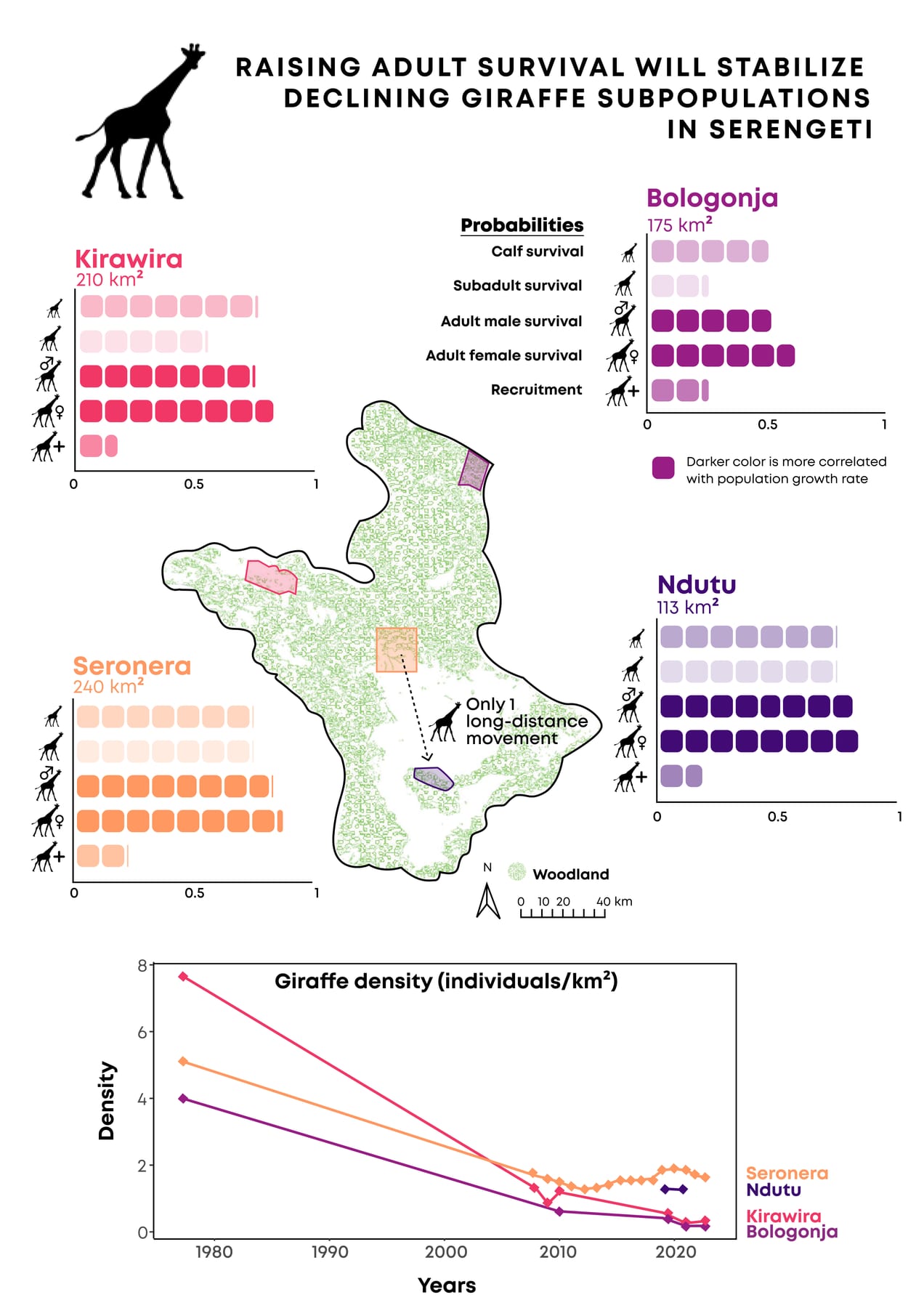
We put together several years of photos and identified 1,520 individual Masai giraffes in four subpopulations (groups living in different parts of the Serengeti). With statistical models, we estimated how many giraffes survived each year, how many calves were born, how many giraffes lived in each area, and how often they moved far. Adult survival differed a lot between subpopulations, and where fewer adults survived, numbers went down.
“Adult survival emerged as the strongest demographic driver of giraffe population trends,” says Dominik Behr, who led the study together with Monica Bond. “This means that improving adult survival is key if we want to prevent further declines.”
We also found that giraffes hardly move between subpopulations: only one giraffe was seen crossing from one to another. So the subpopulations are quite isolated, and few genes flow between them. Over time this could lower their genetic diversity and raise the risk that a local population dies out.
“Giraffes have unique coat patterns, which we use to identify individuals from photographs,” explains Monica Bond. “We combined all available giraffe images—taken during road surveys and from camera traps—to track individual fates and estimate demographic trends over time.”
Earlier studies in the 1970s and 2000s had found dramatic declines, but land use and tourism have changed since then, so it was time for a new look. The central and southern subpopulations, in the middle of the protected areas, are now stable. The western and northeastern ones, along the borders of the protected areas, are still declining. Each subpopulation needs its own conservation plan.
“The best way to conserve giraffes and other large mammals is by protecting large areas of intact habitat,” says George Lohay. “Community conservation efforts have successfully raised adult survival in other parts of Tanzania. Scaling up these initiatives around the Serengeti could make a critical difference.”
“Our work shows how long-term demographic monitoring can guide conservation priorities in complex ecosystems,” says Arpat Ozgul, senior author of the study. “Targeted efforts that improve adult survival in key areas could determine the fate of these isolated subpopulations.”
We did this work with colleagues from the Wild Nature Institute, Pennsylvania State University, Estación Biológica de Doñana and the Grumeti Fund’s RISE program. It is part of our Masai giraffe project and our work on populations under environmental change.