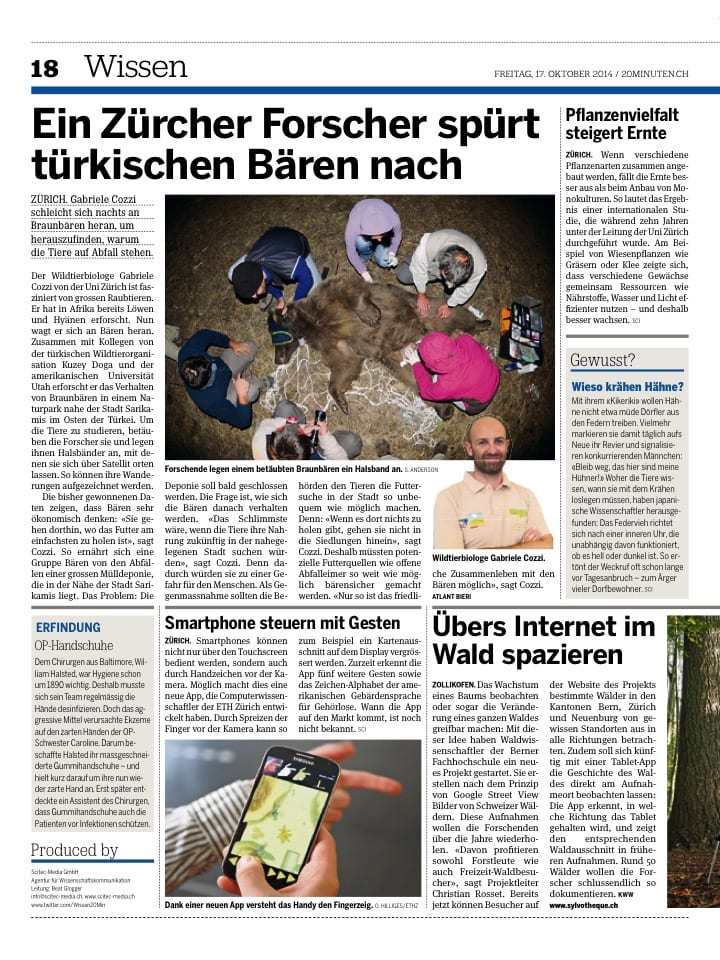
Turkish bears and the McDonald’s effect
“…The bears living in the Sarikamis Forest National Park belong to an isolated and relict population not connected to any other larger and viable bear populations…”. This is what we believed two years ago, at the beginning of the project. And we were wrong!
Now, after two years of continuous data collection from 16 GPS radio-collared bears, we are slowly starting to understand their local and regional movement patterns, their ecology and social organisation.
Together with our collaborators of the Turkish-based NGO KuzeyDoga, the University of Utah, and the University of Zagreb we discovered that our study bears are capable of long-distance movements of more than 100 km. And this across an allegedly hostile and human-dominated landscape. These long distance trips thus allow the bears to reach a larger bear population that lives along the Black Sea coast and across Georgia.
Interestingly, only half of the collared bears undertook these long-distance movements. The other bears never left the surrounding of the Sarikamis forest, instead they regularly visited the Sarikamis city garbage dump.
So we found two quite different kinds of bears: (i) ‘dump bears’, who never left the Sarikamis forest and fed at the city dump, and (ii) ‘wild bears’, who never visited the dump and regularly went on long trips. These trips happened just before hibernation, so we think they are about fattening up for the winter. The dump bears seem to support this idea: they also visited the dump more often just before hibernation.
Future work will allow us to tell which of the two strategies is the most adaptive: McDonald’s fast food or bio-products?
For the time being we are happy to have made it to the public media.
Update: the results were published in 2016 in the Journal of Zoology: Anthropogenic food resources foster the coexistence of distinct life history strategies: year-round sedentary and migratory brown bears.