Leaving by staying: dispersal decisions of young giraffes
Dispersal, when young animals reaching adulthood leave their family, keeps populations genetically healthy and helps them persist in the long run. For most animals, this means a risky journey into the unknown in the hope of finding a new community in which to settle and breed. But many animal societies, including our own, are made up of social communities that share the same space. These could let young animals leave home socially, without having to travel far. Our new paper in the Journal of Animal Ecology shows that this is just what many young giraffes do.
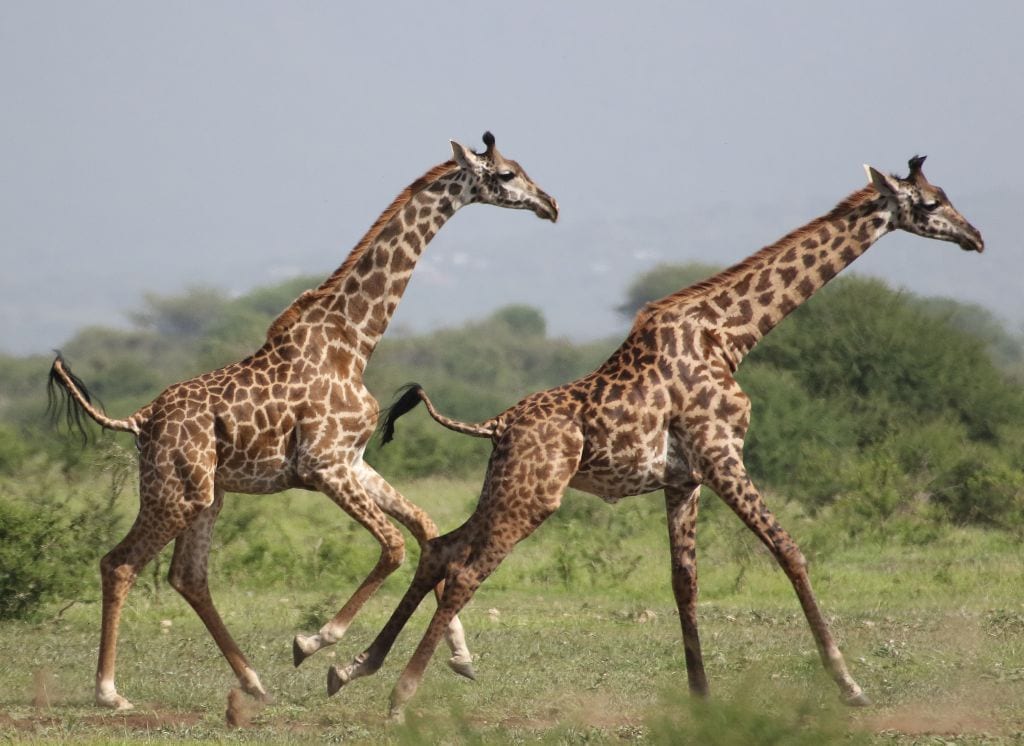
Leaving the family you were born into is called natal dispersal. It lowers the chances of mating with a relative, which helps animals have healthy offspring. Dispersal is first and foremost a social process. Yet it has mostly been studied as a matter of distance, because in most animals families defend an area and keep others out, so the young have to leave that area to start their own family. Led by Monica Bond, we tested whether animals living in societies with overlapping communities could disperse simply by switching communities, and so avoid the risks of moving through the unknown.
We studied hundreds of giraffes over a huge area of 2,200 km2 in northern Tanzania. Most male giraffes leave home once they are old enough to breed, and many of them do so by simply joining a new social community, without moving far from home. Most young females, on the other hand, stayed in the community they were born into. Differences between the sexes in who leaves home are well known in animals, but this is one of the first studies to show how a structured society lets young animals find a new community without moving to a new area.
Complex giraffe societies
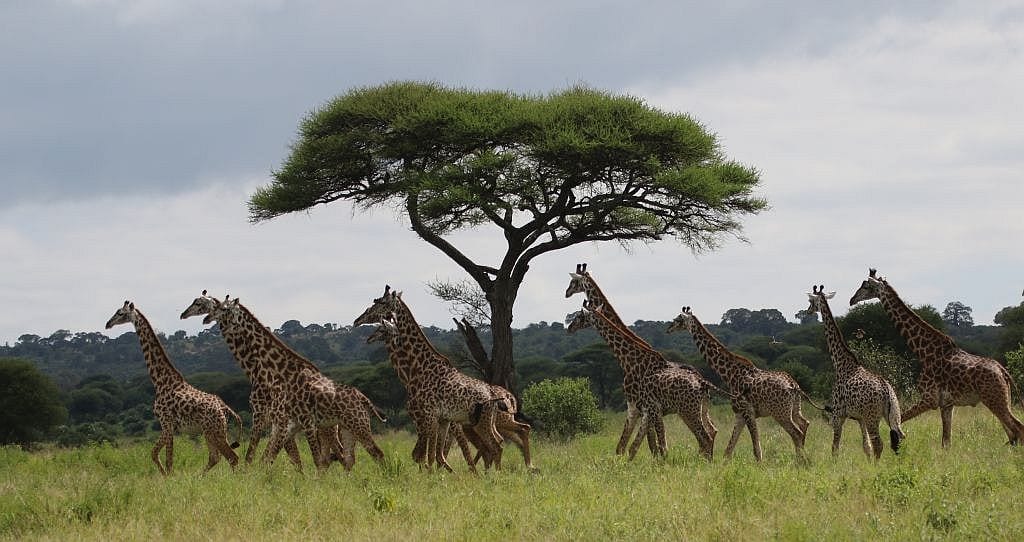
Together with Penn State University, we had shown earlier that adult female giraffes form distinct social communities of about 60 to 90 females. Membership is very stable over time, even though the groups these females form merge and split throughout each day. This has two big consequences. First, females keep lasting bonds with other females in their community, probably for life. Second, the communities are defined by who associates with whom, not by where they live: different communities use the same land. So while giraffes from different communities might meet now and then, they rarely, if ever, form groups together.
“This led us to wonder whether maturing young giraffes might forge relationships with the members of nearby female communities that are different from their birth community, to avoid accidentally mating with their relatives, without having to travel long distances into unknown and possibly dangerous places,” says Damien Farine, co-author and UZH Eccellenza Professor.
As in most other mammals, it was mainly the males that left, at about four years of age. “The key question was then to ask what strategies young males used to find new communities in which they could search for unrelated mates or avoid conflict with relatives,” says Barbara König of the University of Zurich, senior author of the study.
Females stay in the same social networks, males switch
We first mapped the social communities of the adult females, and then followed which community 67 male and 70 female calves spent time with as they grew up over seven years. More than four out of five young males that left home switched to a different community from the one they were born into. And about one in four of these males stayed fairly close to where they were born. In other words, they left home without having to move far at all.
“This type of social dispersal, where males remained close to home but joined different female communities, would not be detected if only spatial movements were measured,” says Monica.
Giraffes may not be the only animals that can leave home socially without moving away. In many other species, including dolphins, elephants and bats, groups merge and split (scientists call this ‘fission-fusion’) within a larger, more stable community. “It would be interesting to see if dispersing socially within the same physical space is a common strategy that is employed in species that live in societies with many overlapping social communities,” Monica says. “Given the importance of maintaining healthy populations, the more we understand the natal dispersal process, the better we can help conserve wildlife.”
According to giraffe expert Fred Bercovitch, who was not part of the study: “This research has crucial implications for the conservation of giraffes because it demonstrates that the preservation of genetic diversity in giraffes requires saving large ecosystems that allow animals to disperse into different communities, and not the translocation of a handful of giraffes to a new area, where breeding opportunities are limited.”
This work is part of our Masai giraffe project.