Human presence weakens social relationships of wild giraffes
Communities of giraffes living close to people carry a tell-tale signature of disturbed social networks. That is what we found in our new study in the Journal of Animal Ecology, together with colleagues from the Max Planck Institute of Animal Behavior and the University of Konstanz, Pennsylvania State University and the Wild Nature Institute. While many of the most charismatic animal species are social, the effects of people on the relationships of wild animals have rarely been studied. Using six years of observations of wild adult female giraffes, we found that giraffes living near people have weaker relationships, with fewer partners. It is the first solid evidence that humans change the social structure of this iconic giant plant-eater.
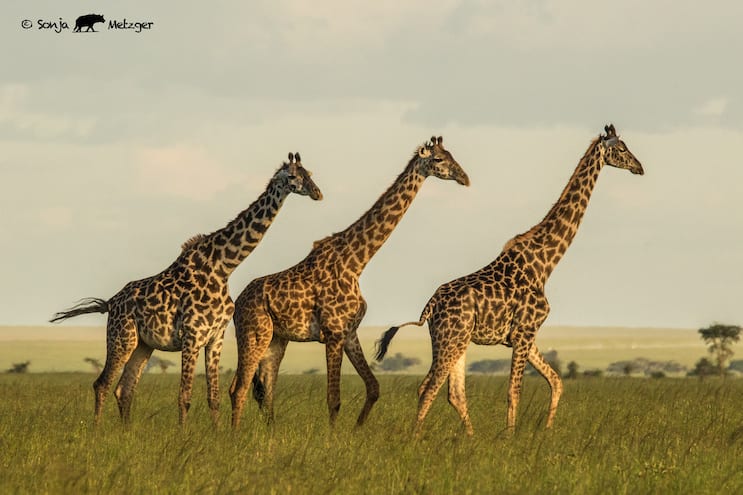
Effects of humans on the social lives of wild animals have rarely been studied
For social animals, including elephants, lions and giraffes, social behaviour is critical for survival and reproduction. Studies of birds kept in the lab have suggested that when social groups are disturbed, their structure changes, and the groups then do less well at tasks that matter for survival, such as feeding together. We know little about how wild animals’ relationships are affected by subtle or indirect disturbance, such as people living and working in their habitat.
Field research in Tanzania gives new insights into giraffe relationships
“Detecting signals of natural versus human-caused influences on social relationships among wild animals is challenging,” says Monica Bond, who led the study. “It requires large-scale studies of individually identified animals across numerous social groups living under different environmental conditions.” Individual giraffes can be recognised by their unique spot patterns, which never change. Over six years, we photographed hundreds of adult female Masai giraffes in a large, unfenced landscape in the Tarangire region of Tanzania, where the amount of human disturbance varies from place to place. From who was seen with whom, we built a social network: a map of their relationships.
The female giraffes in Tarangire live in a complex society with several levels: each female prefers the company of some females and avoids others. The result is separate social communities of 60 to 90 females that hardly mix, even when they share the same area. “This study reveals that social structuring is clearly an important feature of female giraffe populations,” says Barbara König, professor at the University of Zurich and co-author of the study.
In Tanzania, people tolerate giraffes because they do not cause problems for farmers or livestock. “Despite the public tolerance and hunting restrictions, Masai giraffe populations have declined 50% in recent years,” says co-author Derek Lee of Pennsylvania State University, who leads the long-term giraffe study. Several reasons have been suggested, including poaching, habitat loss and fragmentation, lions taking calves when migratory herds decline, and changes in food supply. A disrupted social life may also play a part, but until now it was unclear whether people affect how giraffe society is organised.
We found that giraffes living closer to bomas, the traditional compounds of the Indigenous Masai people, have weaker relationships and keep to fewer partners. “This result signifies a disrupted social environment based upon previous experimental research,” says Damien Farine of the Max Planck Institute of Animal Behavior and the University of Konstanz, senior author of the study. “The patterns we characterise in wild giraffes’ response to proximity to humans reflect the predictions from experimentally disrupted social systems.”
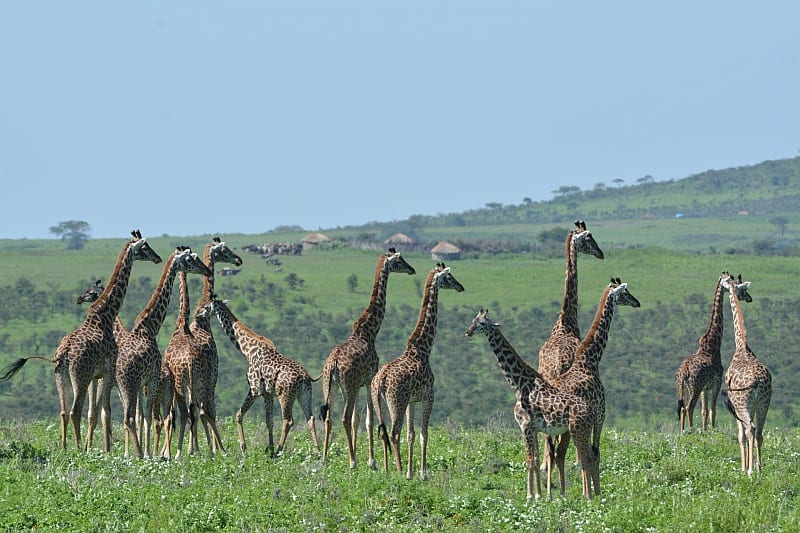
Near bomas, people cut firewood, which can reduce giraffe food, and groups of giraffes are more likely to meet livestock and people on foot, which may cause them to split up. But bomas may also protect giraffes: there are fewer lions and hyenas near them. In other research, we found that female giraffes with calves tended to stay closer to bomas, and that communities closer to bomas had more calves per female. “It seems that female giraffes face a trade-off between maintaining important social bonds and reducing risk to their calves near these traditional settlements,” says Monica. Traditional herding does not have to put giraffes at risk, as long as care is taken not to disturb them too much.
So people could be playing an important role in the future of giraffes, and looking at social networks can reveal causes of population decline that would otherwise stay hidden. “The effects of ever-increasing anthropogenic pressure on wildlife populations are determined by complex interactions of individuals with their social, biological, and physical environment,” says Arpat Ozgul, co-author and head of our group. This work is part of our Masai giraffe project.