Giraffe spots affect survival during heat waves and cold spells
Why do giraffes have spots? In our new paper in Journal of Applied Ecology, led by our postdoc Alexia Mouchet, we look at one possible answer, keeping cool and keeping warm, and find that the size of a giraffe’s spots is linked to its survival during heat waves and cold spells.
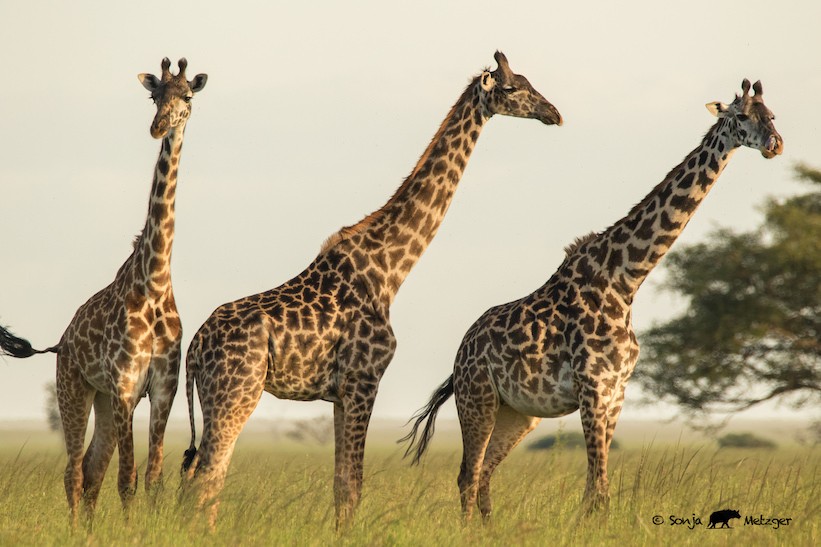
Every giraffe has its own coat pattern, which stays the same from birth to death and is partly inherited from its parents. Spots may help calves hide from predators, but they may also help giraffes control their body temperature: under each spot runs a network of blood vessels that can release heat. If that is the case, which spots are best should depend on the weather.
In our Masai giraffe project in the Tarangire Ecosystem of northern Tanzania, we photograph every giraffe we meet, three times a year, and recognise each one by its coat. For this study we measured the size and shape of the spots of 810 giraffes from photographs taken between 2012 and 2020, and compared them with how long the animals survived and with how unusually hot or cold each season was.
Spots mattered most for calves. Calves with smaller spots, and calves with more irregular, lobed spots, survived better. Temperature changed the picture: in unusually cold seasons, calves with large spots did best, perhaps because larger dark patches absorb more sunlight; in unusually hot seasons, they did worst. Calves with small spots survived about equally well whatever the weather.
Adults differed by sex. In adult males, survival in unusually cold seasons was lowest for those with the smallest spots, and in hot seasons the pattern reversed, though more weakly. Adult females were less affected by their spots, but all females survived less well in unusually hot seasons. As far as we know, this is the first time that spot patterns have been shown to affect survival in adult mammals.
Why does this matter? Giraffes are long-lived and breed slowly, so the survival of adults drives whether populations grow or shrink. If different spot patterns do best under different weather, the variety of patterns within a population may help it cope with a changing climate. Keeping giraffe populations connected, so that animals and their genes can move between them, would help keep that variety.
The study was done with our long-time partners Derek Lee and James Madeli of the Wild Nature Institute and Douglas Cavener of Pennsylvania State University, together with Arpat Ozgul. For more on the same giraffes, see how rainfall, not rising temperatures, threatens their survival, and how baby giraffes hide in bushes from predators.
As always, we thank our donors and partners for supporting our giraffe research.