Are the marmots fat or muscled?
While some are tracking meerkats in South Africa, others are developing complex models in Zurich, I was doing laboratory work at the “Institut Pluridisciplinaire Hubert Curien” in collaboration with the Evolutionary EcoPhysiology Team (Strasbourg, France).
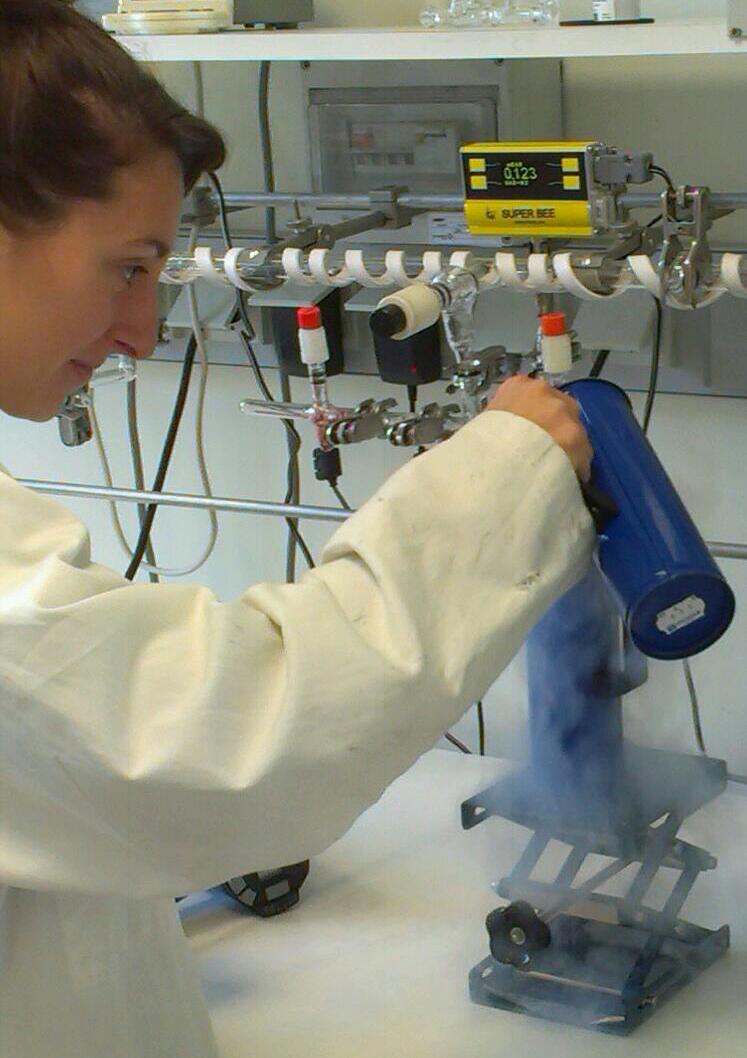
No, no, no, I am not playing with liquid nitrogen for fun…
I am doing cryo-distillation to isolate water from biological fluids (here blood samples).
You probably wondering: What? or Why ? I would answer because we want to demonstrate that:
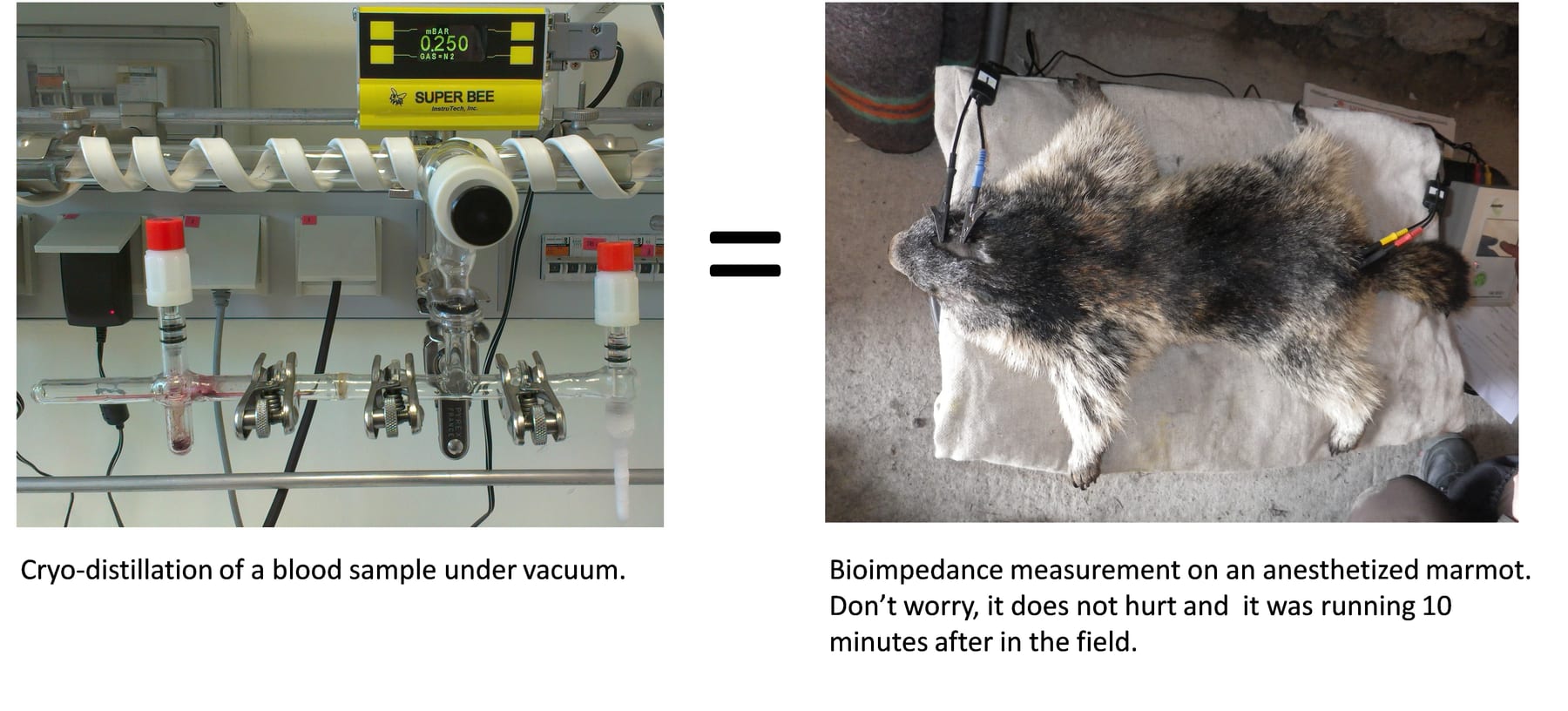
In other words, we want to validate the bioelectrical impedance analysis (BIA) by the deuterium dilution method to measure the body composition of marmots.
The bioelectrical impedance measurement is a non-invasive method to estimate body composition and in particular body fat by determining absolute fluid volumes. It is doing exactly the same as the new scale you have at home! It is based on the fact that an electric current is conducted poorly by fat and bone but conducted well by tissues containing electrolytes and water.
BIA has been used in a number of species to evaluate total body water and thus body composition, including humans, cats, harbor seals, bear, dogs, pigs, horses but never used in marmots before.
So to ensure that this method is also appropriate in marmots, we evaluate the total body water by deuterium concentrations in condensed water from blood sample.
For more information, you can read:
Kyle UG, Bosaeus I, De Lorenzo AD, Deurenberg P, Elia M, Gómez JM, Heitmann BL, Kent-Smith L, Melchior J-C, Pirlich M (2004). “Bioelectrical impedance analysis—part I: review of principles and methods.” Clinical Nutrition 23(5): 1226-1243. pdf