Dewy pines in disturbed habitats face a hotter future
Most long-term studies of how climate change affects plants and animals take place in protected areas. Yet many species now live mainly in landscapes shaped by people. In our new paper in Journal of Ecology, led by our PhD student Eva Conquet, we show that climate change hits a carnivorous Mediterranean shrub much harder where people have changed its habitat.
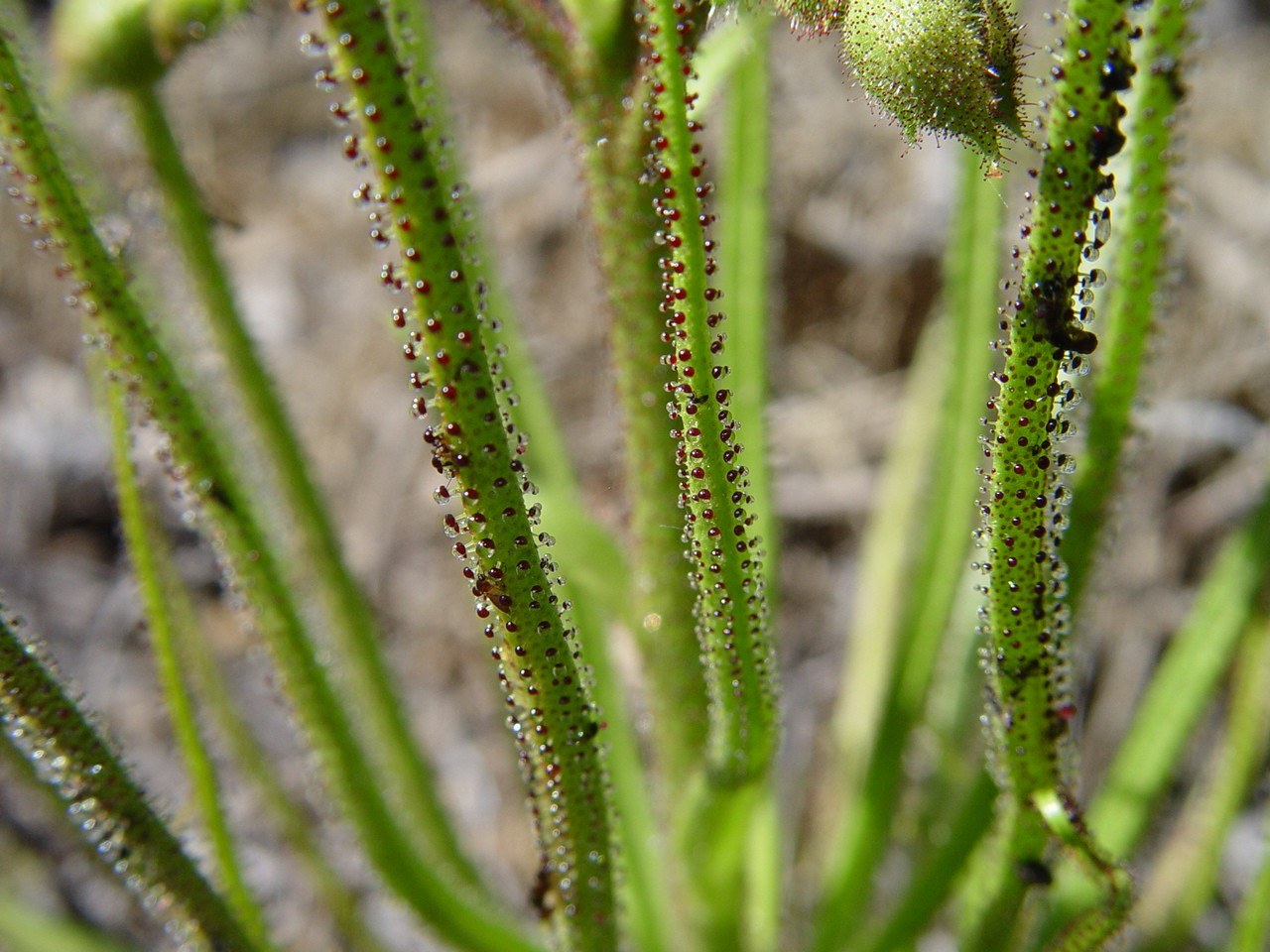
The dewy pine (Drosophyllum lusitanicum) grows in the heathlands of southern Spain, Portugal and northern Morocco. It catches insects on sticky droplets on its leaves, and it depends on fire: after a fire clears the shrubs, its seeds germinate in large numbers. In many places, however, fire has been replaced by grazing or by clearing the vegetation by machine, and most dewy pines now grow in such disturbed sites.
Together with colleagues at the University of Cádiz and Maria Paniw, we followed 4,753 plants for seven years in three natural heathlands and five disturbed sites, and related their survival, growth and flowering to summer heat and rainfall. Hotter summers lowered survival everywhere. In the natural heathlands, rainy years made up for some of this, but in the disturbed sites they did not.
We then projected the populations 30 years into the future under climate change. The natural populations kept the same, fairly low, risk of dying out. The populations in disturbed sites, already declining today, were almost certain to disappear.
What does this mean for conservation? Natural heathlands need their fires, or other ways of opening up the vegetation now and then. In disturbed sites, further disturbance should be avoided, and some shrub cover could shade the dewy pines from extreme heat. More broadly, the study shows why we need long-term studies in landscapes used by people, not only in protected areas.