EEE330 Rotifer experiment
Population Ecology · Autumn 2026 · Lab practical with Stefan Sommer
Over three afternoons (E1–E3, Tuesday 1 to Thursday 3 December, room 13J26) you follow small populations of the rotifer Brachionus calyciflorus for two days and count them by life stage. In P5 (Tuesday 8 December) you analyse everyone’s counts, and you write them up in your lab report.
Printable version (PDF), for the lab bench.
The question
Lake Orta in northern Italy was polluted with copper from a textile factory from 1926. Copper accumulated until the late 1950s; the lake then partly recovered and was limed in the late 1980s. Rotifers leave resting eggs in the sediment, so populations from different periods of the lake’s history can be hatched again in the lab. We compare two of these resurrected Lake Orta populations with a commercial population from the USA.
The film Orta Reloaded (YouTube, in English) tells the story of the lake’s pollution and recovery.
- How do survival, maturation and fecundity respond to copper?
- How do these individual-level responses affect population growth?
- Do the populations respond differently?
Design
Three populations, two copper concentrations and two starting populations. Each tube starts either with 8 juveniles (less than a day old) or with 6 amictic adults, and each combination has 6 to 8 replicate tubes.
| Starting population | Copper (µg Cu L⁻¹) | 1950s | 1980s | USA |
|---|---|---|---|---|
| 8 juveniles | 0 | 6–8 reps | 6–8 reps | 6–8 reps |
| 8 juveniles | 50 | 6–8 reps | 6–8 reps | 6–8 reps |
| 6 amictic adults | 0 | 6–8 reps | 6–8 reps | 6–8 reps |
| 6 amictic adults | 50 | 6–8 reps | 6–8 reps | 6–8 reps |
Each tube holds 8 mL of artificial freshwater with the green alga Chlorella vulgaris as food (10⁶ cells mL⁻¹). Except while you count, the tubes stay in the dark at 20 °C in an incubator. The medium is renewed at every count.
The tubes are coded, so you do not know which population or copper level you are counting until the analysis:
- copper concentration: B, C
- population: R, O, Y
- starting population: J, A
- replicate: 1, 2, 3, …
A tube’s ID combines them, for example B-R-J-1.
Telling the stages apart
Adult females are about 250–300 µm long.
Bright-field microscopy
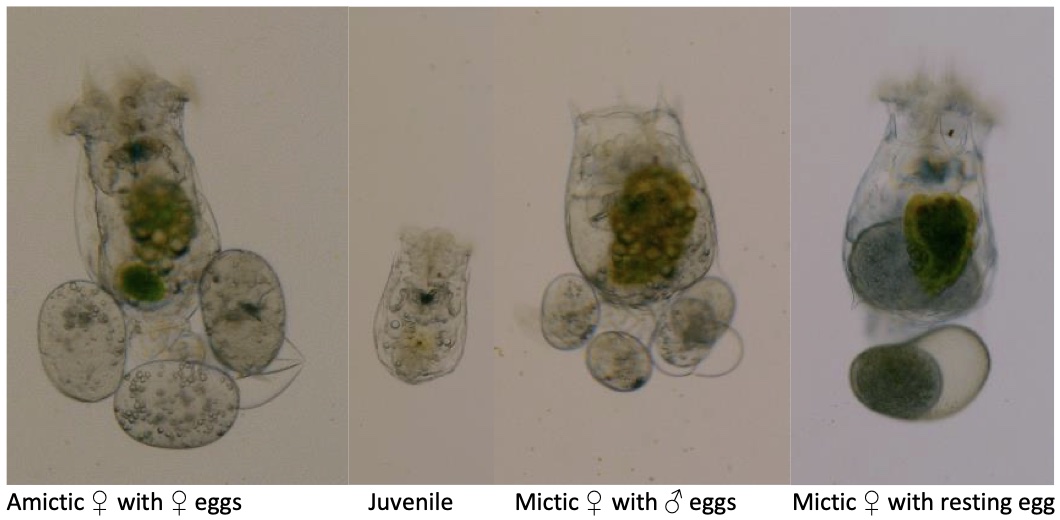
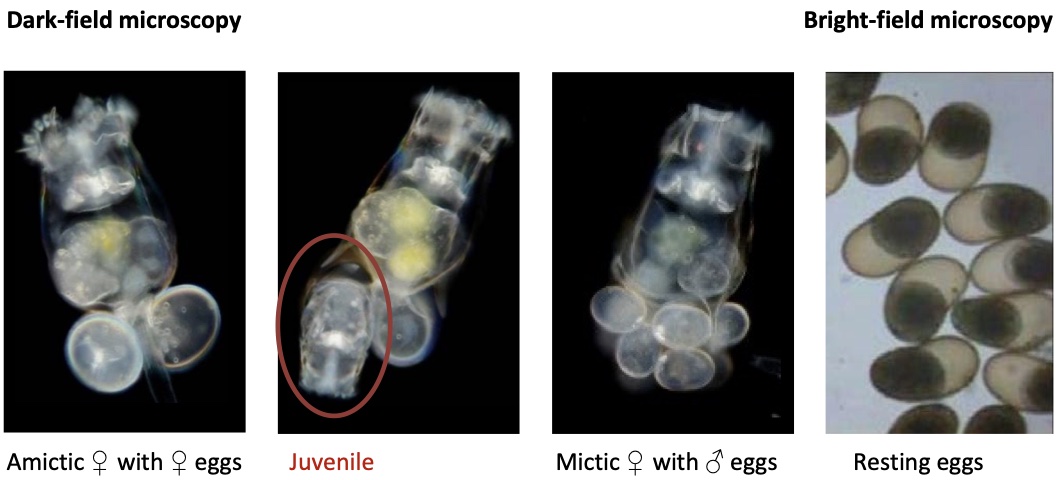
When you count:
- Small rotifers without eggs are juveniles.
- Large rotifers with large (female) eggs are amictic adults.
- Large rotifers without eggs are also amictic adults, unless you see small, empty eggshells attached to the rotifer’s “butt”.
- Large rotifers with small (male) eggs or resting eggs are mictic adults.
- Ignore males.
If in doubt, isolate the rotifer in a water droplet and ask the course assistant.
Procedures
Day 1 (Tuesday, E1): start of the experiment
- Randomly select 4 culture tubes and label them with your name (or initials).
- To each tube, add 8 mL of the indicated medium: B or C.
- To each tube with a blue cap and the letter J, add 8 juveniles from the indicated population: R, O or Y. Rinse the pipette with water before switching to a new population.
- To each tube with a red cap and the letter A, add 6 amictic adults from the indicated population: R, O or Y. Rinse the pipette with water before switching to a new population.
- When you are done, put the tubes in a blue rack.
Day 2 (Wednesday, E2): data collection I
- Pour one of your rotifer cultures into a Petri dish.
- Check under the microscope that all rotifers have been transferred to the Petri dish; if not, transfer the remaining rotifers with a long (1 mL) pipette.
- To the empty culture tube, add 8 mL of the indicated medium: B or C.
- Count all live rotifers in the Petri dish by stage (juveniles, amictic adults, mictic adults; ignore males) and return them to the culture tube.
- Count all dead rotifers by stage: juveniles, amictic adults, mictic adults. Do not transfer them back.
- Enter all counts in the data sheet.
- Discard the old medium, including males and dead rotifers.
- Rinse the Petri dish and the pipette with water.
- Repeat these steps with your next culture.
- When you are done, put the tubes in a blue rack.
Day 3 (Thursday, E3): data collection II
- Collect the data as on Day 2. Because this is the last day of the experiment, you can then discard all rotifers.
- Enter all counts in the data sheet and upload it to your Participant Folder on OLAT by Thursday evening at the latest.
Data sheet
Download the data sheet (Excel). It has one row per tube and day: the tube’s code (copper, population, starting population, replicate), the day, and the numbers of live and dead juveniles, amictic adults and mictic adults, with a column for comments. Day 1 rows hold the numbers you put in.
After the experiment, Stefan compiles everyone’s sheets into one file, which you analyse in P5.
Lab report
Download the lab-report template (Word). It gives the Introduction and Methods in part and asks you to complete them, then write the Results and Discussion; the papers it cites are linked in its reference list.
- Upload your report as a PDF named Lastname_Report.pdf to your Participant Folder on OLAT by Monday 4 January 2027, the first Monday in January.
- The report is 30% of the course grade.
- AI tools may be used for any task, provided you declare every use in the report (the template has a section for it).
Questions about the experiment or the report: Stefan Sommer, .